
Rice is the staple food for more than half of the world‘s population, and its cultivation remains labor-intensive in many parts of Asia, where smallholder farmers still transplant rice seedlings by hand. Manual transplanting requires 25 to 30 person-days per hectare, depending on soil type. As rural labor forces shrink and wages rise, farmers are increasingly turning to mechanization. The global rice transplanter market was valued at approximately USD 1.65 billion in 2025 and is projected to reach USD 2.59 billion by 2033, growing at a compound annual growth rate (CAGR) of 5.8%. Asia-Pacific accounts for the largest share of this market, driven by extensive rice cultivation in China, India, Japan, Indonesia, and Southeast Asian countries. But what is a rice transplanter, and why has it become an essential tool for modern rice farming?
What Is a Rice Transplanter?
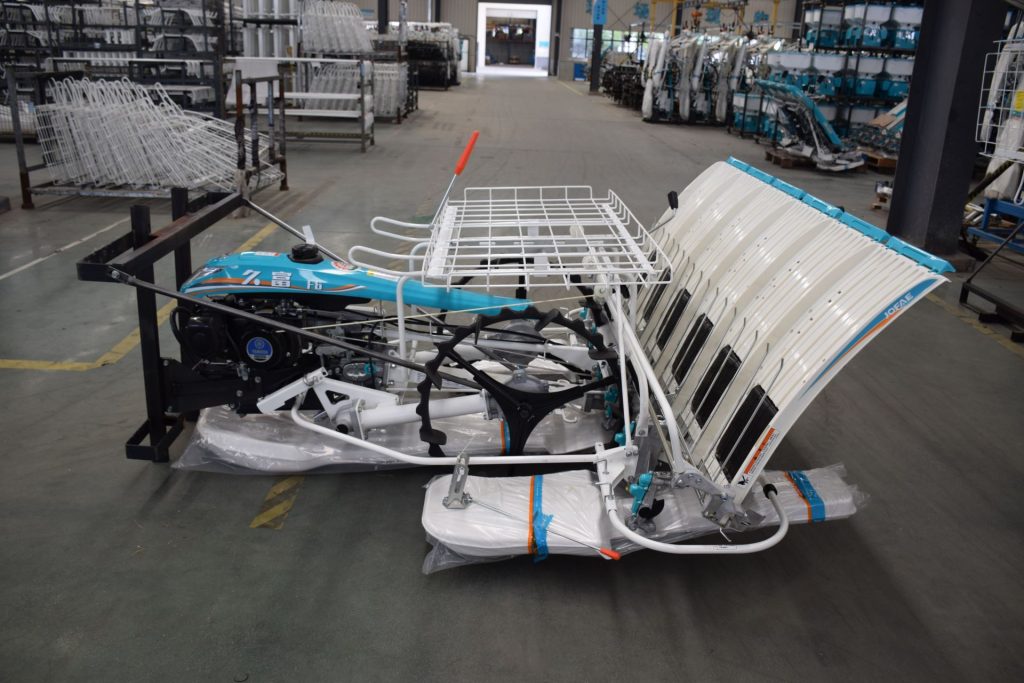
To understand what a rice transplanter is, one must first recognize the fundamental challenge it addresses: the back-breaking, time-consuming work of manually planting rice seedlings one by one in flooded paddies. A rice transplanter is a specialized agricultural machine designed to transplant young rice seedlings from nurseries directly into paddy fields. It automates the entire planting process—from picking seedlings to inserting them into the soil at precise intervals.
In essence, what a rice transplanter does is replace the human hand and bending posture with a mechanical system that ensures consistent row spacing, plant-to-plant distance, and planting depth. This precision is critical for maximizing yield potential, as uniform planting allows each seedling to receive optimal sunlight, water, and nutrients.
The history of the rice transplanter dates back more than a century. The first patent for a rice transplanter was granted in Japan in 1898 to a farmer named Heigoro Kono-. However, it was not until the 1960s that rice transplanters found practical application, with development and spread progressing rapidly during the 1970s and 1980s. In 1970, Kubota succeeded in the mass production of rice transplanters, responding to farmers‘ growing need for ride-on machinery that facilitated easy and quick planting. The first manually operated 6-row rice transplanter was developed and used in China in 1950. Today, what started as a farmer’s innovation has evolved into a sophisticated piece of agricultural machinery available in various configurations worldwide.
How Does a Rice Transplanter Work?
A rice transplanter operates through a coordinated sequence of mechanical actions. The process begins with seedling preparation. Seedlings are raised in special mat nurseries or seedling trays and are typically ready for transplanting within 12 to 15 days after seeding-.
The machine‘s core components include:
- Seedling tray: Holds the mat-type nursery seedlings.
- Seedling tray shifter: Moves the tray gradually, similar to a typewriter mechanism, ensuring seedlings are fed to the planting mechanism continuously.
- Pickup forks: These forks extract 3 to 5 seedlings from the mat and insert them into the soil, simulating the action of human fingers.
- Float: Glides across the puddled field surface, keeping the machine balanced and stable.
- Engine and transmission system: Provides power to both the ground wheels and the planting mechanism.
The engine drives the ground wheels while simultaneously powering the crank mechanism of the planting system. The velocity ratio between the ground wheel and the crank determines the spacing between plants-. As the machine moves forward, the pickup forks extract seedlings from the tray and transplant them into the soil at the predetermined row spacing (typically 30 cm), plant spacing (12–18 cm), and depth (2–6 cm). Most transplanters of this type operate using a link mechanism driven by a crank arm-.
Advanced models feature rotary-type planting mechanisms with non-circular gears that can achieve even higher speeds and more precise planting trajectories-. Some modern machines are also equipped with electronically controlled automatic balance systems to maintain consistent planting depth across uneven terrain.
Types of Rice Transplanters
Rice transplanters come in several configurations, each suited to different farm sizes, budgets, and operational needs. They are broadly categorized by operation mode, power source, and row capacity.
By Operation Mode
Walking Type (Walk-Behind)
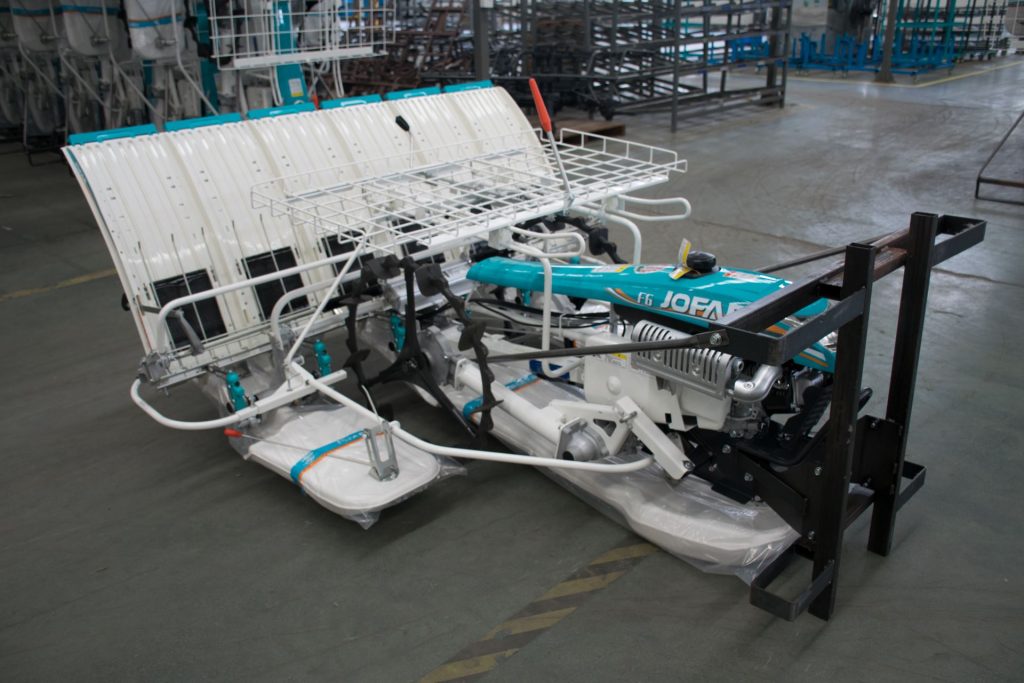
Walking-type rice transplanters are operated by a farmer walking behind the machine. These are typically used on small to medium-sized farms. They are available in both manual and self-propelled versions. A 2-row walking type transplanter has shown low percentages of missing hills (0.5%), buried hills (1.5%), and floating hills (1.0%)-. Walking-type models are particularly useful for own farming operations.
Riding Type (Ride-On)
Riding-type rice transplanters allow the operator to sit on the machine, reducing fatigue and enabling higher operational speeds. These machines are preferred by larger farms and service providers for their higher field capacity, greater row options, and better ergonomics-. Riding-type transplanters hold the largest share of the global market, driven by their high-speed and multi-row capabilities-. For farmers seeking maximum efficiency, the High-Speed Riding-Type Rice Transplanter offers advanced automation, durable construction, and ergonomic design to optimize transplanting operations.
Drone/Unmanned Solutions
Emerging technologies include drone-based and unmanned transplanting solutions, which are still in early stages of adoption but represent the future direction of rice transplanting mechanization.
By Power Source
Rice transplanters can be powered by gasoline, diesel, or electric motors. Diesel-powered models are common for larger, heavy-duty operations, while electric and battery-powered transplanters are gaining traction as sustainable alternatives.
By Row Capacity
- Less than 4 rows: Suitable for very small farms and hilly terrain.
- 4 to 8 rows: The most common range, balancing capacity and maneuverability.
- More than 8 rows: Used in large-scale commercial farming operations.
JOFAE, for example, offers walk-behind models with 2.6 and 3.3 KW engines, while its ride-on lineup ranges from 17.8 to 235 KW with options from 4 to 8 rows of planting.
Key Benefits of Rice Transplanters
The adoption of rice transplanters delivers tangible benefits across multiple dimensions—efficiency, yield, cost, and quality.
Efficiency Gains
Mechanical transplanting dramatically outperforms manual labor. One study found that a self-propelled rice transplanter achieved a field capacity of 0.11 hectares per hour, with an average planting efficiency of 97.4% and field efficiency of 93.98%—well above the minimum 80% efficiency required by standards. JOFAE reports that its transplanters enable farmers to be 20 times more efficient than manual transplanting.
Yield Increases
Uniform planting depth, spacing, and plant density are crucial for maximizing yield potential-. Farmers who adopted mechanical transplanting have reported at least a 12% increase in yield due to uniform planting-. Research indicates that mechanical transplanting can result in a 5 to 10% increase in yield compared to manual methods-. Straw yield in mechanically transplanted fields was also found to be 4.2% higher.
Cost Savings
The economic case for rice transplanters is compelling. In India, the cost of mechanical transplanting is approximately Rs 1,250 per hectare, compared to Rs 3,750 per hectare with manual methods-. A Philippine farmer using a mechanical transplanter saw his expenses drop to PhP 400 per hectare-. Overall, the benefit–cost ratio of mechanical transplanting versus manual methods has been calculated at 3.44 and 2.42, respectively—a clear indication of superior economic returns.
Precision and Quality
Mechanical transplanting ensures consistent row spacing, plant spacing, and depth, which are difficult to achieve with manual labor. This uniformity reduces competition among plants for light, water, and nutrients, leading to healthier crops and higher yields. Additionally, mechanical transplanters minimize seedling damage and improve survival rates.
Addressing Labor Shortages
Perhaps the most critical benefit is the ability to address the growing labor shortage in rural areas. As young workers migrate to cities, finding enough labor for peak transplanting seasons has become increasingly difficult and expensive. Mechanical transplanting reduces drudgery and ensures timely completion of transplanting work, which is essential for optimal crop establishment.
How Much Is a Rice Transplanter?
The cost of a rice transplanter varies widely depending on type, features, row capacity, and brand. Below is a general price range for different categories:
| Type | Price Range |
| Manual walk-behind models | $150 – $300- |
| Basic walk-behind (self-propelled) | $2,000 – $5,000 |
| Semi-automatic riding units | $8,000 – $15,000 |
| Fully automatic riding models | $15,000 – $30,000+ |
In 2025, the global production of ride-on high-speed rice transplanters reached 85,430 units, with an average selling price of approximately US$15,275 per unit. Multifunctional riding rice transplanters had a global production of 88,503 units, with an average selling price of US$12,500.
Semi-automatic rice transplanters typically cost between $2,500 and $5,500, while fully automatic models range from $8,000 to $16,000 or more. Higher-end models with advanced electronic controls, GPS navigation, and greater row capacities command premium prices. When purchasing, it is advisable to compare multiple offers and be cautious of prices that fall significantly below the market average, as this may indicate hidden defects.
Conclusion
So, what is a rice transplanter in the context of modern agriculture? It is far more than a simple machine—it is a transformative tool that addresses one of the most labor-intensive tasks in rice cultivation. From its humble beginnings with a farmer‘s patent in 1898 to today’s high-speed, GPS-guided riding models, the rice transplanter has revolutionized how the world‘s most important food crop is planted.
By replacing back-breaking manual labor with precision mechanization, rice transplanters deliver higher yields, lower costs, and greater efficiency. They enable farmers to plant more land in less time, with better crop establishment and higher profitability. As the global population continues to grow and rural labor becomes scarcer, the role of the rice transplanter will only become more critical.
Looking ahead, the future of rice transplanting lies in further automation—electric powertrains, autonomous navigation, drone-based solutions, and integration with precision agriculture systems. For farmers around the world, from the rice terraces of Southeast Asia to the commercial paddies of the Americas, the rice transplanter is not just a machine; it is the key to sustainable, productive, and profitable rice farming for generations to come.