
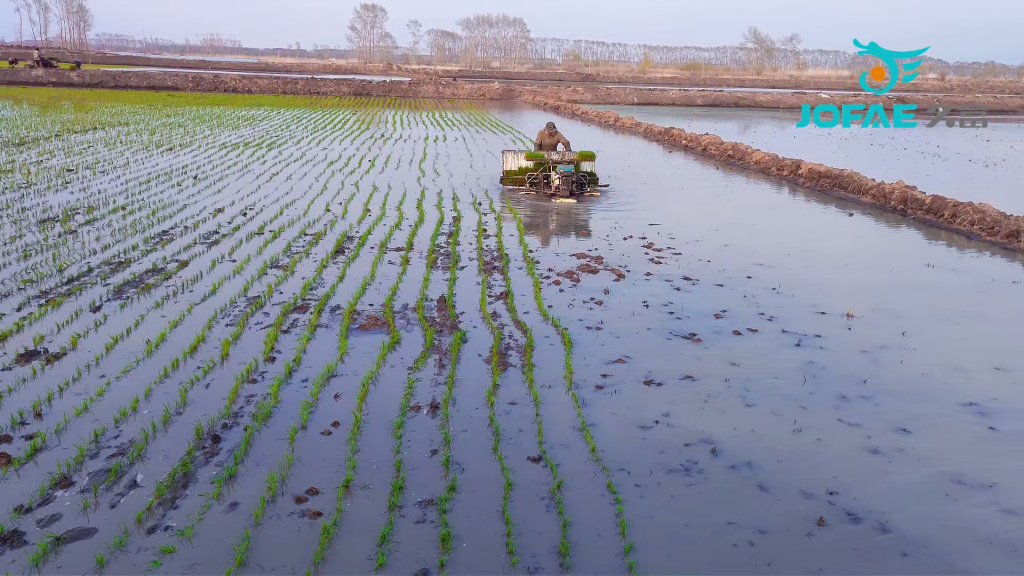
Have you ever wondered how to make a rice transplanter that delivers consistent performance season after season? While the concept seems straightforward—a machine that picks seedlings from a tray and plants them into paddy soil—the reality of manufacturing a reliable rice transplanter involves precise engineering, rigorous quality control, and a multi-stage production process.
In this article, we’ll take you behind the scenes of a professional factory to explore exactly how to make a rice transplanter from raw materials to finished product—covering material selection, frame fabrication, powertrain assembly, planting mechanism calibration, surface finishing, and final testing.
Raw Material Selection:The Foundation of Quality
Every great machine starts with the right materials. When learning how to make a rice transplanter, the first critical decision is choosing steels that can withstand the harsh paddy environment—constant mud, water, and dynamic loads.
Most module components of a rice transplanter are made of ST37 steel and S45C carbon steel (hardened). ST37 provides excellent weldability and formability for structural frames, while S45C offers superior wear resistance for moving parts like shafts and gears. The main frame typically uses high-strength steel sections—often 25×25mm triangular steel—joined through electric welding to ensure long-term stability without displacement or deviation.
For components that contact water and mud directly—such as the floating board and seedling tray—manufacturers often specify zinc-plated or galvanized materials to prevent corrosion. The main body structure must be able to withstand various loads during the transplanting process, which is why professional factories use either welded or cast high-strength steel for the core frame.
Precision Cutting and Frame Welding
Once materials arrive at the factory, the actual process of how to make a rice transplanter machine begins with precision cutting and fabrication.
Modern manufacturing facilities employ CNC processing equipment to cut steel sections with exact tolerances. The frame sections are then clamped to fixture die plates, and robotic or mechanized welding is performed using MIG, TIG, or robotic welding techniques. For agricultural machinery frames, mechanized welding with melting electrodes in protective gas environments (typically 80% CO₂ and 20% Ar) ensures strong, reliable joints with minimal deformation.
The welding process is critical because the modular frame of a planting machine undergoes repeated dynamic loads during use—shocks, vibrations, and repeated stresses. Poor welding can lead to material fatigue and reduced machine lifespan. Professional manufacturers follow strict welding procedures to ensure every joint meets strength and durability standards.
After welding, the frame undergoes deburring and surface preparation to remove sharp edges and prepare for the coating process.
Power Transmission System Assembly
The heart of any rice transplanter is its power transmission system. When manufacturers figure out how to make a rice transplanter that operates efficiently, the chain-sprocket transmission is where engineering precision truly matters.
The transmission system typically consists of a gear box, drive shaft, sprockets, and chains. A driving sprocket mounted on the drive shaft connects through a chain to the central sprocket, transmitting power to the planting mechanism. The chain is typically simplex type, and the transmission connects the main drive to the feeding transmission.
Key components in the transmission train include:
- Connecting rods and levers that convert rotational motion to reciprocating action
- Cranks that determine plant spacing
- Planting finger forks that execute the actual picking and planting motion
Professional assembly requires precise alignment of all transmission components. Even minor misalignment can cause excessive wear, power loss, or inconsistent planting. Factories use specialized jigs and fixtures to ensure proper chain tension and sprocket alignment during assembly.
For manufacturers producing manual versions, the transmission is deliberately simplified—often relying solely on wheel‑driven chain systems without an engine. Understanding how to make a manual rice transplanter means knowing how to reduce component count while maintaining consistent picking and planting timing. Our walk‑behind models use this exact principle, with a lightweight gear train that keeps both cost and maintenance low.
Planting Finger Calibration:The Precision Step
This is arguably the most critical step in how to make a rice transplanter that delivers low vacant hill rates and uniform planting. The planting fingers (or transplanting fingers) are mechanical claws that pick seedlings from the tray and insert them into the soil.
Planting finger calibration involves two key adjustments:
- Horizontal adjustment: Controls the lateral position of the pick
- Vertical adjustment: Controls the depth and timing of the pick
Research shows that enlarging the adjustment of planting fingers directly correlates with the number of seedlings planted per hill and a decline in vacant hill rate. For example, a 4-row walking type transplanter with 10mm horizontal × 14mm vertical adjustment typically achieves 4.48 seedlings per hill with a vacant hill rate of 7.5%. By contrast, an 8-row riding type with 14×14mm adjustment can achieve 6.74 seedlings per hill with only 2.5% vacant hills.
Planting fingers tend to wear out quickly during operation, so manufacturers use hardened steel for these components and design them for easy replacement-. The fingers must be calibrated to pick 2-3 seedlings per hill consistently—too few and you get vacant hills; too many and you waste seedlings and risk broken or cut plants.
The planting depth is another critical parameter, typically adjustable between 20-70mm depending on soil conditions and seedling age-. Depth must be calibrated against mud feet depth—too deep drowns the tiller, too shallow causes floating.
Surface Finishing and Corrosion Protection
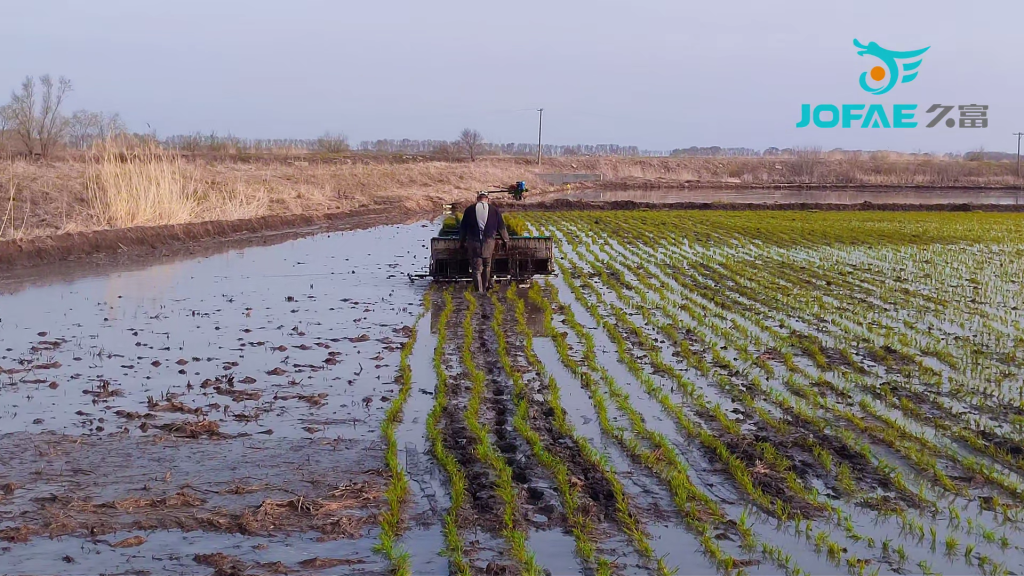
Rice transplanters work in wet, muddy conditions—making corrosion protection essential. Professional factories apply multi-layer coating systems to ensure longevity.
The most advanced protection method is cationic electrodeposition painting. In this process:
- Parts undergo pre-treatment (cleaning and phosphating)
- Cationic paint is applied using electricity, creating a thin, even coating
- The coating is highly resistant to rust and provides excellent coverage even in hard-to-reach areas
Some manufacturers also use powder coating as an additional layer or alternative-. After spraying, powder coatings provide excellent color and light retention, as well as acid rain resistance-. The coated components are then baked in ovens (typically at 180°C for 10 minutes) to achieve the required coating hardness and durability.
This finishing process isn’t just about aesthetics—it directly impacts the machine’s working life in the field.
Quality Testing Before Leaving the Factory
No discussion of how to make a rice transplanter would be complete without covering the testing phase. Professional manufacturers follow ISO9001 international quality management systems, with everything managed by quality documents and standard operating procedures.
Factory testing typically includes:
1. Component-level inspection
Verification of mechanism dimensions, materials, and accessories against manufacturer specifications-. This includes checking that all welded joints meet strength requirements and all moving parts operate smoothly.
2. Assembly verification
Testing the complete machine for proper operation of all systems—transmission, planting mechanism, depth adjustment, and floating board movement. The planting clutch is tested to ensure it engages and disengages power to the fingers properly.
3. Field performance testing
The ultimate test happens in actual paddy conditions. Key metrics evaluated include:
- Missing hill rate: Target <5%
- Floating hill rate: Target <5%
- Buried hill rate: Target <5%
- Damaged seedling rate: Target <2%
- Field efficiency: Typically 65-75%
Field tests also verify that the machine achieves the specified planting depth, row spacing, and hill spacing. The floating board is checked to ensure it creates proper corrugation in the field for smooth, straight-line movement.
Testing protocols are also tailored to each machine type. For example, the Walk-Behind Rice Transplanter undergoes additional stability tests on uneven paddy surfaces, and its handle vibration is measured to ensure operator comfort. These checks are part of our standard quality assurance, and they vary from riding‑type models only in the specific jigs and load cells used.
Why Factory-Made Beats DIY
After understanding the full scope of how to make a rice transplanter in a professional factory—from material science and robotic welding to precision calibration and multi-stage testing—it’s clear why factory-made machines outperform any DIY attempt.
Professional manufacturers have:
- Advanced equipment including CNC processing and automatic testing machinery-
- Exquisite workmanship backed by years of engineering experience
- Complete quality systems with every step documented and verified
- R&D teams that continuously improve designs based on field feedback
When you purchase a professionally manufactured rice transplanter, you’re not just buying a machine—you’re investing in reliability, performance, and peace of mind.
Conclusion
Understanding how to make a rice transplanter reveals the complexity behind what appears to be a simple machine. From ST37 steel frames and S45C hardened components to precision-calibrated planting fingers and cationic electrodeposition coatings, every step requires expertise, precision, and rigorous quality control.
Whether you’re considering a Walk-Behind Rice Transplanter for a small farm or a larger riding-type model for commercial operations, choosing a professionally manufactured machine ensures you get the durability, efficiency, and planting accuracy that no makeshift solution can match. As a specialized manufacturer with years of field-driven R&D, JOFAE designs and builds every transplanter to withstand real-world paddy conditions—delivering consistent performance season after season. The next time you see a rice transplanter working in a paddy field, you’ll know exactly what went into making it—and why choosing an experienced manufacturer like JOFAE makes all the difference.