
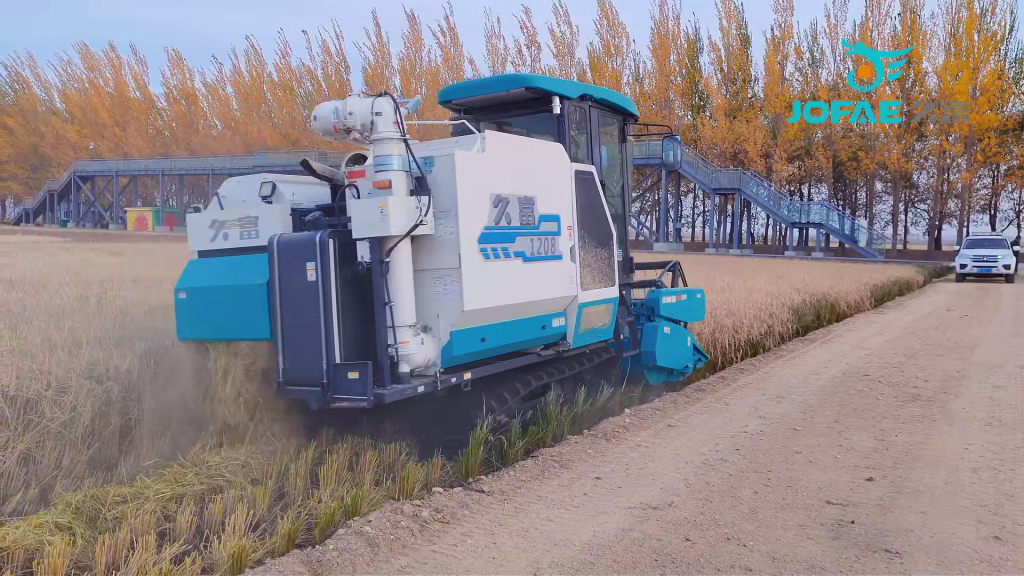
The modern combine harvester —or simply “combine”—is one of the most economically important labor-saving inventions in agricultural history. It is a machine designed to harvest a variety of grain crops by combining three separate harvesting operations—reaping, threshing, and winnowing—into a single process.
But the question remains: who invented the combine harvester? The answer is not as simple as naming a single person. The combine harvester is the product of multiple inventors across different continents and decades, each building upon the work of those who came before. Let’s trace the full story.
The Earliest Attempt: Reverend Patrick Bell (1826)
The story begins not in America, but in Scotland. In 1826, Reverend Patrick Bell (1799–1869) designed a reaper machine that used scissor-type blades to cut grain crops. His machine was pushed by horses and could harvest at about one acre per hour-. Bell’s reaper incorporated several design features that would later be adapted into early combine harvesters.
However, Bell never patented his invention. As a clergyman, he reportedly believed that patenting a machine designed to alleviate human suffering was morally wrong. Because of this decision, Bell is rarely credited as who invented the combine harvester—though his contribution to the development of mechanical harvesting is undeniable.
If you ask when was the first combine harvester invented, some might point to Bell’s 1826 reaper. But strictly speaking, Bell’s machine was a reaper, not a combine—it could cut crops but could not thresh or winnow them. The true “combine” would come later.
The True First: Hiram Moore and John Hascall (1834–1836)
The most authoritative answer to who invented the combine harvester is Hiram Moore of Michigan, with the assistance of his neighbor and lawyer, John Hascall.
In 1834, near the village of Climax, Michigan, Hiram Moore built and put into practical use the first successful grain combine harvester—a machine he named the “Thresher”. Unlike Bell’s reaper, Moore’s machine could simultaneously reap, thresh, and winnow grain. It was drawn by horses or mules and represented a revolutionary leap forward in agricultural efficiency.
Moore’s invention was so effective that in 1839, a version pulled by 20 horses harvested more than 20 hectares (about 50 acres) in a single day.
On June 28, 1836, Moore received US Patent No. 9,793X for his combined harvester-thresher. This patent is the clearest answer to the question when was the combine harvester invented—1834 for the build, 1836 for the patent.
So when people ask who invented combine harvester, the most historically accurate answer is Hiram Moore, with John Hascall as his collaborator. The Smithsonian Institution’s Hiram Moore Collection documents this invention in detail, confirming that Moore built “the first successful grain combined harvester” in 1834.
The Same Year, Different Machine: Cyrus McCormick (1834)
Interestingly, 1834 was a busy year for agricultural innovation. In the same year that Hiram Moore was building his combine in Michigan, another American inventor—Cyrus McCormick—was granted a patent for his mechanical reaper.
However, McCormick’s machine was only a reaper, not a combine. It could cut grain but could not thresh or winnow it-. This distinction is crucial when answering who invented the combine harvester. McCormick invented the reaper; Moore invented the combine harvester. The two are often confused, but they are fundamentally different machines.
McCormick’s reaper went on to become enormously successful commercially, while Moore’s combine remained a regional curiosity for decades. But in terms of who first combined reaping, threshing, and winnowing into a single machine, the credit belongs to Moore.
The Australian Contender: Hugh Victor McKay (1884–1885)
While Hiram Moore is the undisputed answer to who invented the combine harvester, he was not the only inventor to claim the title. Half a world away, a young Australian named Hugh Victor McKay developed his own version of the combine.
In 1883, McKay—then only 17 years old—read about the Californian combine harvester and became inspired–. Working with his brother John and his father, he built a prototype stripper-harvester by January 1885 using the most primitive of tools-. He patented the Sunshine Harvester on March 24, 1885.
McKay’s machine revolutionized wheat harvesting in Australia and sold throughout the world-. He later founded the Sunshine Harvester Works, which became the largest agricultural machinery manufacturer in the southern hemisphere.
So does this mean McKay was who invented combine harvester? Not exactly—Moore preceded him by half a century. But McKay was arguably the first to successfully commercialize the combine on a global scale-. The difference between Moore and McKay reflects a broader pattern: Moore invented it, McKay marketed it.
This also explains why, when you search who invented combine harvester, you may find conflicting answers—Americans credit Moore, Australians credit McKay, and both have legitimate claims depending on how you define “invented”.
From Animal Power to Self-Propelled: The Evolution
Once the basic concept of the combine was established, the technology continued to evolve:
- 1836: The horse-drawn “combination harvester–thresher” introduced in Michigan was later adopted in California, where the dry climate made mechanical harvesting more practical.
- 1854: Moore’s combines were shipped to California, where they finally performed well in the dry, sunny conditions that Michigan’s wet climate had prevented.
- 1930s: Combines were not widely adopted until the 1930s, when tractor-drawn models finally became available–. This was the moment when the combine truly transformed global agriculture.
- 1938: Massey-Harris introduced the MH-20, the world’s first commercially successful self-propelled combine harvester. This machine not only separated the tractor from the trailed reaper but also popularized the term “combine harvester” itself.
- 1940s–1950s: Other manufacturers followed, including International Harvester (1942), John Deere (1946), and Gleaner (1950).
- 1970s: Rotary (rotor-type) designs were introduced, further improving threshing efficiency.
- Late 20th century: Onboard electronics were added to measure threshing efficiency and monitor yield in real time.
Conclusion: One Machine, Many Inventors
So, who invented the combine harvester? The most definitive answer is Hiram Moore, who built the first successful grain combine in 1834 and received a patent for it on June 28, 1836. His machine—drawn by horses or mules—could reap, thresh, and winnow grain in a single pass, making it the true predecessor of every modern combine harvester in use today.
But the full story is richer than a single name:
- Patrick Bell provided the earliest mechanical reaper in 1826, inspiring future inventors.
- Hiram Moore and John Hascall built and patented the first true combine harvester.
- Cyrus McCormick popularized the mechanical reaper in the same year, though his machine was not a combine.
- Hugh Victor McKay commercialized the combine in Australia and brought it to the world market-.
- Massey-Harris introduced the first self-propelled combine in 1938, giving us the modern machine we know today.
The combine harvester is not the work of a single genius but the result of a century-long relay of innovation across Scotland, the United States, and Australia. So whether you ask who invented the combine harvester, when was the combine harvester invented, or when was the first combine harvester invented—the answer always leads back to Hiram Moore, and the 1830s, when a revolution in agriculture first began.