
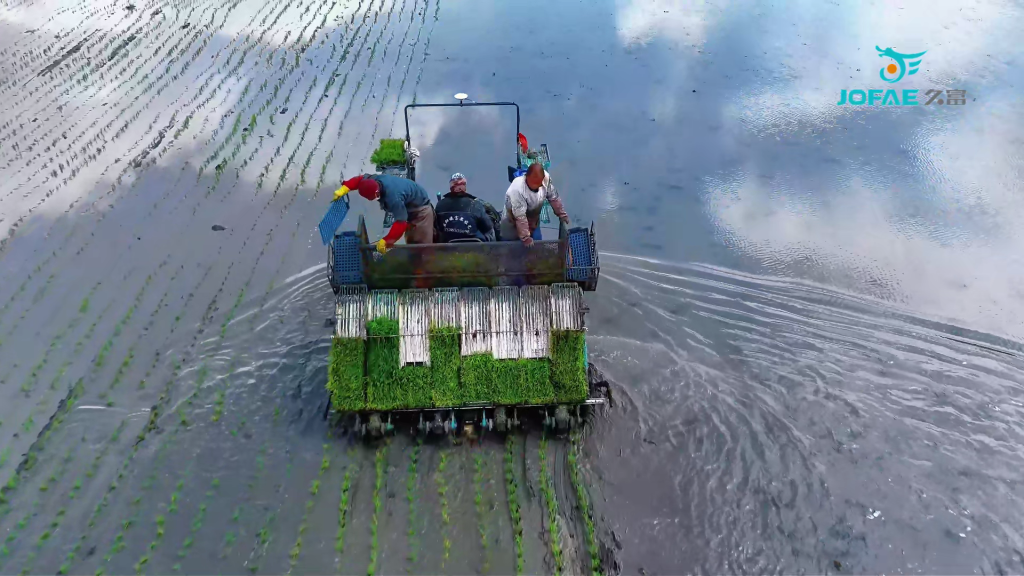
Introduction: What Is a Rice Transplanter?
A rice transplanter is a specialized agricultural machine designed to automate the process of transplanting rice seedlings from nurseries into puddled farmland. Before the advent of this machinery, rice transplanting was entirely manual—a backbreaking, time-consuming task that required farmers to bend over for hours in flooded fields. Today, mechanical transplanters have revolutionized rice cultivation by dramatically improving planting speed, precision, and overall crop uniformity.
Rice transplanters are generally categorized into two main types based on their operation mode: the walk-behind type (manually pushed, usually planting 4 rows at a time) and the riding type (engine-driven, typically planting 6 rows or more per pass). To fully grasp how rice transplanter works, it is essential to look beyond its external appearance and dive into the intricate mechanical coordination of its components. Modern machines, such as the High-Speed Riding-Type Rice Transplanter, are equipped with advanced hydraulic systems and precise gear mechanisms that allow them to plant seedlings at consistent depths and spacing, far surpassing the capabilities of traditional manual labor.
The Working Principle of the Rice Transplanter
This section forms the technical core of our article, breaking down the mechanical logic behind how rice transplanter works in detail.
Core Principle Overview
At its heart, how rice transplanter works is based on the “group sequential grid seedling picking and direct transplanting” method. Instead of planting seeds directly into the soil (like a seeder), the transplanter takes pre-grown seedlings—usually cultivated in special nursery trays as “mat-type” seedlings—and mechanically inserts them into the muddy ground.
The process mimics the human hand’s “pick-move-insert-return” cycle. Seedlings are neatly arranged on a seedling tray (the magazine). As the tray moves laterally, a picking mechanism (the transplanting claw) takes a small, predetermined amount of seedlings from the mat. Under the control of a trajectory-guiding mechanism, the claw moves downward, inserts the seedlings into the soil at a precise depth and angle, and then retracts to pick the next batch. Understanding this continuous cycle is the key to understanding how rice transplanter works efficiently in the field.
The Power Transmission Path – How the Engine Drives the Planting Action
To thoroughly understand how rice transplanter works, we must first trace the power flow from the engine to the moving parts. The transplanting mechanism is driven by the machine’s engine, which typically operates at a speed of around 40 RPM (revolutions per minute). Interestingly, the same engine simultaneously powers the ground wheels of the transplanter.
Here is the step-by-step power transmission path:
- Engine Output: The engine generates rotational power.
- Coupling & Worm Shaft: The power is transmitted through a coupling to the worm shaft.
- Worm Gear & Chain Drive: The worm gear and chain transmission system reduce the speed and transfer the power to the crank of the transplanting mechanism.
- Synchronization: The speed ratio between the ground wheels and the transplanting crank determines the plant spacing (the distance between each hill of rice). Because the engine powers both the forward movement and the planting claws, the system is perfectly synchronized—ensuring that the machine plants uniformly regardless of its forward speed. This synchronization is a critical aspect of how rice transplanter works to avoid skipped or overcrowded hills.
The Mechanical Action of Picking and Transplanting
The most intricate part of how rice transplanter works lies in the precise mechanical movements of the picking and transplanting process. When the machine is in operation, the transplanting claw (also called the seedling picker) moves under the control of a drive mechanism and a trajectory control mechanism.
To maintain the correct planting posture—ensuring the seedlings stand upright at a 90-degree angle to the ground—the front tip of the mechanical claw must follow an elliptical (oval) trajectory. This complex elliptical motion is achieved using a planetary gear mechanism or a deformed gear mechanism, which ensures that the claw enters the soil vertically and exits smoothly without damaging the tender seedlings.
The detailed sequence of the planting action is as follows:
- Picking: The needle-like claw inserts into the seedling mat and grips a specific quantity of seedlings (along with a small block of nursery soil).
- Transferring: The claw moves downward along the elliptical path, carrying the seedlings towards the prepared muddy field.
- Inserting: When the claw reaches the preset planting depth, a pushing fork (or seedling pusher) located inside the mechanism moves forward to push the seedlings off the claw and into the soil. This prevents the claw from pulling the seedlings back out as it retracts.
- Depth Control: The consistency of the planting depth is maintained by a floating board and a hydraulic system. The floating board glides over the surface of the mud, and the hydraulic system automatically adjusts the relative position between the floating board and the transplanting claw, ensuring that all seedlings are planted at the same depth—even if the field is slightly uneven. This depth control is essential to how rice transplanter works effectively in real-world paddy conditions.
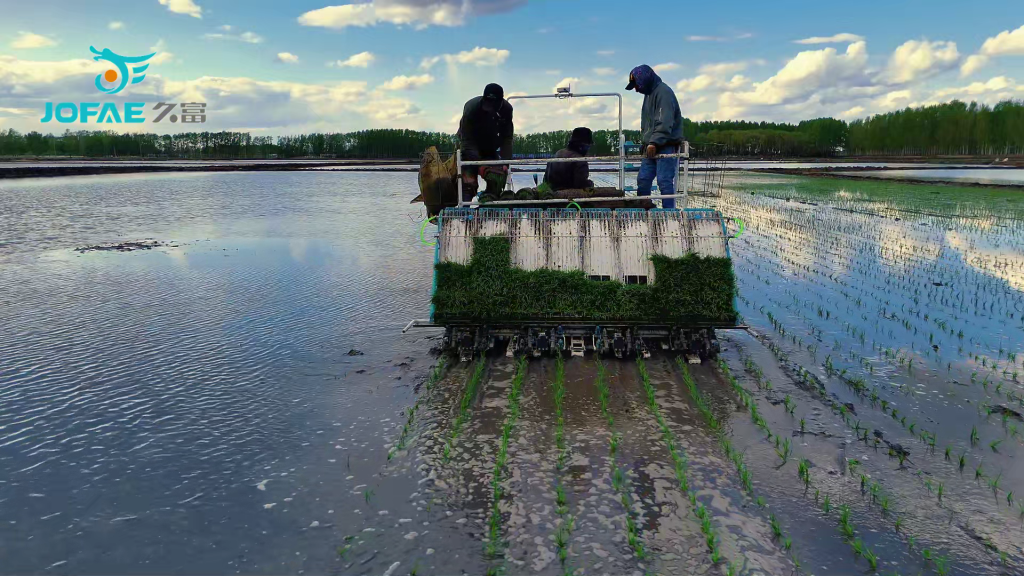
Core Components of the Rice Transplanter and Their Functions
To fully appreciate how rice transplanter works, it is helpful to understand the specific roles of its primary mechanical components:
- Seedling Tray (Magazine): This is the platform that holds the mat-type seedlings. It works in conjunction with the seedling feeding mechanism to deliver seedlings continuously to the picking point. The lateral (horizontal) shifting mechanism moves the tray back and forth to align the seedlings with the seedling gate (the entry point for the claws).
- Transplanting Mechanism (Picking and Planting Assembly): This is the “heart” of the machine. It consists of the picking claws, their drive mechanism, and the trajectory control mechanism (the planetary gears). This assembly is responsible for executing the actual picking and inserting actions.
- Seedling Feeding Mechanism: This operates in two directions:
- Longitudinal Feed: Moves the seedling mat forward (in the direction of travel) towards the claws.
- Lateral Feed: Moves the entire seedling tray horizontally so that the claws pick seedlings from different parts of the mat sequentially, ensuring the entire mat is used up efficiently.
- Frame and Floats: The frame is the structural backbone that supports all other components. It must be rigid yet lightweight. The floats are large, boat-like plates attached to the bottom of the frame; they prevent the machine from sinking too deeply into the soft mud and help stabilize it during operation.
- Walking Device (Drive Wheels): These are specially designed, lugged wheels that provide traction in slippery, muddy paddy conditions without getting stuck. They are essential for the forward movement and power transfer.
- Power Drive Unit: This includes the engine, the transmission gearbox, the clutch, and the control levers. It provides the necessary power to drive both the walking mechanism and the transplanting mechanism simultaneously.
Step-by-Step Working Process of the Rice Transplanter
Breaking how rice transplanter works down into sequential steps makes the process easier to visualize:
- Seedling Preparation (Nursery): Before transplanting, seedlings are grown in specialized nursery trays for about 12 to 15 days until they form a dense, mat-like root structure. This “mat” allows the mechanical claws to pick up seedlings cleanly without breaking the roots.
- Loading the Seedlings: The prepared seedling mats are placed flat onto the seedling trays (magazines) on the transplanter.
- Feeding (Lateral Movement): Once the machine is moving, the seedling tray begins to move horizontally (side-to-side) like a typewriter carriage. This lateral feed moves the mat towards the seedling gate so the claws always have a fresh supply of seedlings to pick.
- Picking (Grabbing): The transplanting claws (needles) extend forward and pierce the seedling mat, grabbing a precise amount of seedlings (usually a small cluster of 3-5 plants per hill).
- Transplanting (Inserting): The claws follow the predetermined elliptical trajectory and move downward. They push the seedlings into the mud at the exact pre-set planting depth and spacing (fixed row spacing, depth, hill spacing, and seedling count per hill).
- Returning: After the seedling pusher pushes the seedlings off the claws and into the mud, the claws retract upward and backward, returning to their original position. The lateral feed shifts the tray slightly, and the cycle repeats immediately—moving forward, picking, and planting in a continuous, rhythmic motion.
Rice Transplanter vs. Manual Transplanting: Efficiency and Benefits
Understanding how rice transplanter works also means understanding why it matters. The shift from manual labor to mechanical transplanting offers undeniable economic and agronomic advantages:
- Operational Speed: One person using a walk-behind transplanter can cover approximately 10,000 square meters per day, compared to just 700 square meters when transplanting manually—a staggering 14-fold increase in daily productivity.
- Seed Savings: Mechanical transplanting uses significantly fewer seeds—only about 19 kg/ha compared to 66 kg/ha in manual broadcasting, because the machine plants precisely spaced hills.
- Cost Reduction: Production costs drop dramatically. Studies show that mechanical transplanting reduces costs to about $577/ha, compared to $719/ha for manual transplanting.
- Higher Yields: Because the machine ensures consistent depth, spacing, and plant population, yields often increase from 7.91 MT/ha (manual) to 8.26 MT/ha (mechanical). The benefit-cost ratio improves from 2.42 to 3.44 in favor of mechanical transplanting.
- Labor Efficiency: Tractor-driven riding-type transplanters can increase labor productivity by up to 32.22 times, freeing farmers to focus on other critical farming activities like water management and pest control.
This efficiency is precisely why more farmers worldwide are adopting mechanical solutions to replace the exhausting manual methods of the past.
Conclusion
In conclusion, how rice transplanter works centers on a mechanized cycle that mimics manual transplanting—picking, inserting, and returning—with precise coordination of power, trajectory, and depth control. This standardization ensures every seedling is planted at uniform depth, angle, and spacing, leading to healthier crops, better resource use, and higher yields.
At JOFAE, we design our transplanters to embody these core principles, delivering reliable, high-performance solutions that help farmers meet growing food demands. As rural labor becomes scarcer, understanding how rice transplanter works is no longer optional—it is a critical step toward efficient, sustainable agriculture, and JOFAE is committed to driving that progress.